Best Budget Travel Destinations for 2026: Your Money Goes Further Here
You know that moment when you’re scrolling through beautiful travel photos, imagining yourself somewhere completely new, and then you check the flight prices? Suddenly, that dream vacation doesn’t feel quite so dreamy.
I’ve been there.
But here’s the good news: travel doesn’t have to cost a fortune. In 2026, there are still plenty of destinations where you can enjoy great food, comfortable accommodation, memorable experiences, and plenty of local culture without draining your savings.
Of course, travel costs have changed. Inflation has pushed prices up in many popular destinations, major events such as the FIFA World Cup are affecting demand in some regions, and flights can be unpredictable. At the same time, currency fluctuations, new airline routes, and competition between destinations are creating some surprisingly good opportunities for budget-conscious travelers.
The trick is knowing where your money will go furthest.
You don’t need to be an experienced backpacker or spend hours hunting for obscure travel deals. A little planning can make a huge difference.
Whether you’re planning your first international adventure, looking for an affordable getaway, or simply wondering where you can get the most value in 2026, this guide will help you make smarter choices.
So, what actually makes somewhere a budget-friendly destination?
Let’s take a closer look.
What Makes a Destination Budget-Friendly in 2026?
The phrase “budget destination” gets used constantly, but what does it really mean?
Put simply, it’s a destination where your money gives you relatively good value compared with your home country or more expensive tourist destinations.
That could mean inexpensive accommodation, affordable restaurants, cheap public transportation, low-cost attractions, or a favorable exchange rate.
And importantly, affordable doesn’t automatically mean uncomfortable.
You might stay in a charming guesthouse instead of a luxury resort, eat at family-owned restaurants rather than expensive tourist establishments, and take public transportation instead of taxis. The experience can still be excellent.
Think about two travelers taking two-week vacations.
One spends thousands of dollars in an expensive destination, eats at tourist restaurants, and constantly worries about costs. Another chooses a more affordable country, stays somewhere comfortable, eats local food, and has enough money left over for activities and spontaneous experiences.
The difference isn’t necessarily how carefully they spend.
It’s where they choose to spend it.
That’s why destination selection matters so much in 2026.
Why Are Some Destinations Cheaper Than Others?
Travel prices aren’t random. Several factors determine whether a destination feels affordable or expensive.
Understanding them can help you identify good-value destinations before everyone else discovers them.
Currency Exchange Rates Can Work in Your Favor
Exchange rates are one of the biggest factors travelers should watch.
When your home currency gains value against another currency, accommodation, meals, transportation, and activities can become more affordable.
For example, if your currency becomes 10% stronger against the currency of your destination, your purchasing power there effectively increases.
Japan and South Korea have attracted attention from travelers because of currency movements that can make visiting more affordable for people carrying stronger currencies.
But exchange rates can move in either direction. A destination that was inexpensive last year may not offer the same value today.
The takeaway: Check current exchange rates before booking rather than relying on what a travel blog said two or three years ago.
Tourist Taxes and Extra Fees Are Becoming More Common
Another cost travelers sometimes overlook is the growing number of tourism-related taxes and fees.
Some destinations charge visitor taxes, environmental fees, hotel taxes, or entrance charges.
These costs may seem small individually, but they can add up over a week or two.
Venice, for example, introduced an entry fee for certain day visitors, while Bali introduced a tourist levy. European cities also commonly add local accommodation taxes.
The lesson is simple: don’t judge affordability based solely on the advertised hotel or flight price.
Look at the total cost of the trip.
Inflation Doesn’t Affect Every Country Equally
Inflation has changed the traditional idea of what counts as a cheap destination.
Some places that were backpacker favorites a decade ago are considerably more expensive today. Other countries have remained relatively affordable.
Thailand, for example, can still offer excellent value, but popular areas are noticeably more expensive than they once were.
Vietnam continues to be a strong choice for travelers looking for affordable accommodation, food, and transportation.
Eastern Europe and parts of Southeast Asia also remain attractive for budget-conscious travelers.
The important point is to research current prices, not historical ones.
New Airline Routes Can Create Great Deals
Airline competition can completely change the affordability of a destination.
When new carriers enter a market or airlines add routes, fares can fall as companies compete for passengers.
Emerging destinations such as Morocco, Georgia, and Colombia have benefited from increased connectivity in recent years.
For travelers, this creates an opportunity: sometimes the cheapest destination isn’t the one you’ve been dreaming about. It’s the one airlines happen to be competing to reach.
Best Ways to Travel on a Budget in 2026
Now we get to the practical part.
Choosing an affordable destination is only half the equation. How you travel once you get there can have just as much impact on your final bill.
Here are nine strategies worth trying.
1. Be Flexible With Your Flight Dates
You’ve probably heard that Tuesday is the magical day to book flights.
The reality is a little more complicated. Airlines use dynamic pricing, so there isn’t one universal day that guarantees the lowest fare.
Instead, focus on flexible travel dates.
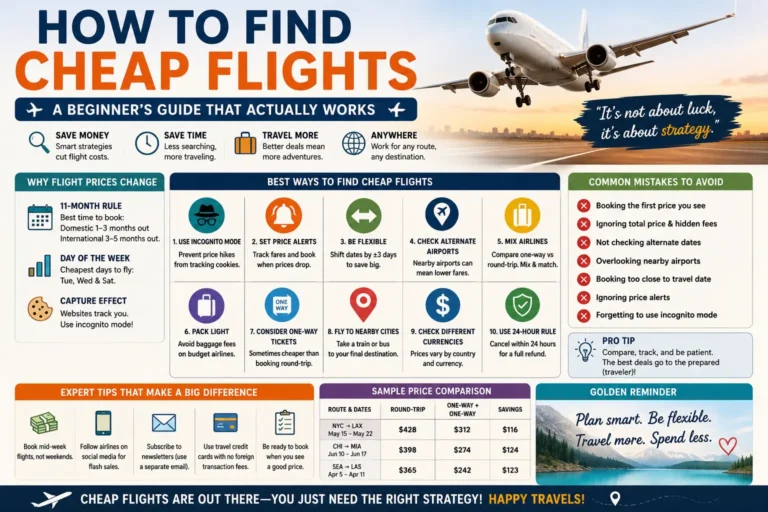
Compare departures on different weekdays, check nearby dates, and look at several airports.
For example, moving a Friday departure to Wednesday could potentially save you a significant amount depending on the route and demand.
Common mistake: Assuming the first fare you see is the best available price.
Compare several dates before booking.
2. Use “Everywhere” Search Tools
If you’re flexible about where you go, this can be one of the most useful budget-travel strategies.
Flight search tools that allow an “Everywhere” or explore-style search can show you destinations based on price rather than forcing you to start with a specific city.
You might discover that your preferred destination costs $900 while another equally interesting country costs $400.
That’s a big difference.
Instead of asking:
“How can I afford to visit Spain?”
Try asking:
“Where can I afford to go?”
That small change in thinking can open up completely different possibilities.
3. Consider Boutique Hostels and Guesthouses
Hostels aren’t necessarily the cramped dorm rooms many people imagine.
Today, plenty offer private rooms, en-suite bathrooms, communal kitchens, workspaces, lounges, and even swimming pools.
A private hostel room can sometimes cost considerably less than a comparable hotel.
Guesthouses can also be excellent value, particularly in smaller cities and towns.
Another advantage is the social side. You may meet travelers who want to split transportation costs, join tours together, or recommend inexpensive local restaurants.
The trick: Don’t automatically choose the absolute cheapest property.
A slightly more expensive, highly rated accommodation can be much better value if it gives you a good night’s sleep and a safe, comfortable location.
4. Eat Where Locals Eat
Food can quietly destroy a travel budget.
Eating breakfast, lunch, and dinner at restaurants located beside major attractions can become expensive surprisingly quickly.
Instead, walk a few blocks away from the busiest tourist areas.
Look for restaurants filled with locals.
Visit markets.
Try street food where appropriate.
Pick up fresh ingredients for a picnic.
For example, paying €20 or more for an average meal beside a major landmark isn’t unusual. Walk fifteen minutes into a residential neighborhood and you might find something more authentic for half the price.
And often, it’s better.
Budget rule: Save your money for meals that are actually worth remembering.
5. Use Public Transportation
Taxis and rideshares are convenient, but using them for every journey can eat through your budget.
Public transportation is often dramatically cheaper.
Metro systems, buses, trams, trains, and local transit passes can make a huge difference over several days.
Before arriving, download a navigation or transit app and learn the basics of the local system.
It might seem confusing for the first hour.
After that, you’ll probably wonder why you ever considered taking a taxi everywhere.
6. Travel With Carry-On Luggage
Packing light isn’t just about convenience.
It can save money.
Budget airlines frequently charge additional fees for checked luggage, and those fees can become substantial when you’re taking multiple flights.
A carry-on also makes moving around easier. You can use trains, buses, and public transportation without struggling with multiple suitcases.
You don’t need a different outfit for every day.
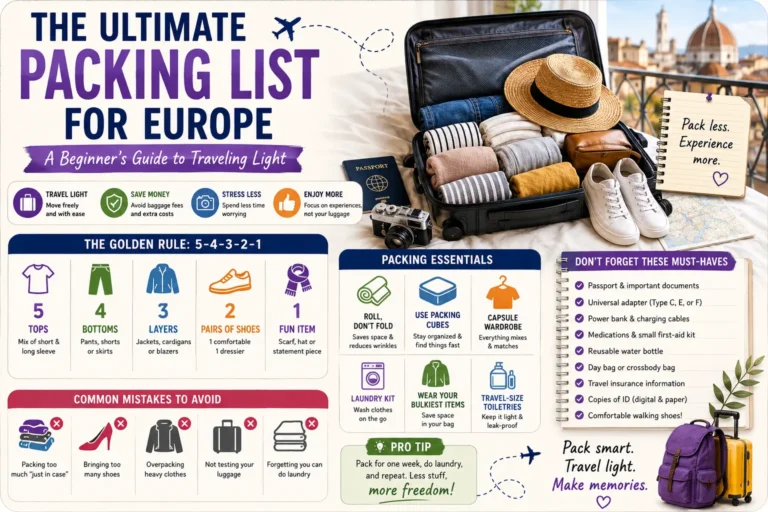
Pack versatile clothes, do laundry when necessary, and leave the “just in case” items at home.
You’ll probably discover that you needed far less than you thought.
7. Consider Overnight Transportation
An overnight train or bus can sometimes combine transportation and accommodation into one expense.
You travel while you sleep and arrive at your next destination in the morning.
This can work particularly well on longer routes.
However, don’t assume every overnight journey will be comfortable.
Research the route, read recent reviews, and check exactly what kind of sleeping arrangement you’re getting.
A proper sleeper train can be a memorable part of the trip.
A cramped overnight bus might be something you’ll never want to repeat.
Choose carefully.
8. Take Free Walking Tours
Many major destinations offer walking tours where guides work primarily for tips.
These tours can be a fantastic introduction to a city.
You’ll learn about major landmarks, local history, neighborhoods, food, and sometimes hidden spots that aren’t obvious from a guidebook.
They can also help you decide which attractions deserve your money and which ones you can happily skip.
Just remember that “free” generally means tip-based, not that the guide works for nothing.
If you enjoyed the tour and can afford it, tip appropriately.
9. Use Travel Credit Card Rewards Carefully
Travel points and cashback can reduce your travel costs considerably.
Some cards offer rewards or welcome bonuses that can be used toward flights and hotels.
But there’s one rule you shouldn’t break:
Never carry expensive credit card debt just to earn travel rewards.
If interest charges accumulate, the rewards quickly stop being worthwhile.
Use a card for expenses you can already afford, pay the balance in full, and understand the program’s rules before chasing bonuses.
Expert Budget Travel Tips Most People Overlook
Sometimes the biggest savings don’t come from obvious tricks.
They’re hidden in the small decisions people make before and during a trip.
Calculate Your Entire Trip Budget Before Booking
Don’t get excited by a cheap flight and book it immediately.
First calculate the approximate cost of:
- Flights
- Accommodation
- Food
- Local transportation
- Travel insurance
- Attractions
- Tours
- Visa fees
- Airport transfers
- Shopping
- Emergency expenses
Then add a buffer of roughly 10–15%.
A $500 flight doesn’t mean you have a $500 vacation.
The total cost is what matters.
Check Secondary Airports
Sometimes the cheapest flight isn’t to the airport you initially searched.
Major cities may have multiple airports, and budget airlines often operate from secondary ones.
For example, travelers visiting London can compare Heathrow with Gatwick, Luton, and Stansted. Paris travelers can compare Charles de Gaulle with other nearby airports.
But don’t look only at the airfare.
Calculate the total journey cost, including transportation from the airport to your accommodation.
A $40 cheaper flight isn’t actually cheaper if the airport transfer costs $70.
Walk Away From Major Attractions Before Eating
This simple trick can save a surprising amount of money.
Restaurants directly beside major landmarks often charge more because tourists are willing to pay for convenience and location.
Walk several hundred meters away.
Look for neighborhood restaurants.
Check menus before sitting down.
And if a restaurant is completely empty during a busy meal period while every local restaurant nearby is packed, that’s worth noticing.
Check Your Credit Card’s Existing Travel Benefits
Before purchasing travel insurance, check whether your existing credit card already provides relevant coverage.
Some cards may include benefits related to trip cancellation, baggage, rental vehicles, or travel emergencies.
However, don’t assume you’re fully covered.
Read the policy carefully. Check exclusions, eligibility requirements, coverage limits, and whether you had to purchase the trip using that particular card.
Free coverage isn’t useful if it doesn’t cover your situation.
Compare Direct Booking With Third-Party Prices
Third-party travel websites are useful for comparing prices, but don’t automatically assume they’re the cheapest final option.
Once you’ve found a hotel or flight you like, check the provider’s own website.
Look at the complete price, including baggage, breakfast, cancellation conditions, taxes, and other fees.
Sometimes direct booking is cheaper.
Sometimes the third-party website wins.
The point is to compare the total package rather than the headline number.
Common Budget Travel Mistakes to Avoid
Even experienced travelers occasionally make expensive mistakes.
Here are some of the most common.
Mistake 1: Booking Without Comparing Dates
A small change in departure date can sometimes produce a substantial difference in airfare.
Better approach: Compare several dates before committing.
Mistake 2: Eating Every Meal at Restaurants
Three restaurant meals every day can consume a huge portion of your budget.
Better approach: Combine restaurants with markets, groceries, street food, picnics, and accommodation kitchens.
Mistake 3: Exchanging All Your Money at the Airport
Airport exchange counters often have less favorable rates and additional fees.
Better approach: Compare your bank’s options, reputable ATMs, and exchange rates before converting large amounts of cash.
If an ATM offers dynamic currency conversion, carefully check whether using your bank’s exchange rate instead is better.
Mistake 4: Paying Unnecessary Baggage Fees
Packing too much can become expensive.
Better approach: Travel light, check your airline’s exact baggage allowance, and weigh your luggage before leaving home.
Mistake 5: Ignoring Visa Requirements
A cheap flight is worthless if you aren’t eligible to enter the country.
Visa and entry requirements depend on your nationality and can change.
Better approach: Check the destination’s official government or immigration website before booking non-refundable travel.
Mistake 6: Skipping Travel Insurance
An emergency abroad can cost dramatically more than an insurance policy.
Medical treatment, cancellations, lost baggage, and emergency transportation can quickly become expensive.
Better approach: Compare policies and make sure the coverage actually fits your destination and activities.
Mistake 7: Assuming Every “Free” Tour Is Completely Free
Some tours operate on tips, while others may use the experience to promote partner businesses.
Better approach: Read recent reviews and understand how the tour operates before joining.
Mistake 8: Forgetting an Emergency Buffer
No matter how carefully you plan, something can go wrong.
A delayed flight. A broken phone. An unexpected taxi. A missed connection.
Better approach: Keep around 10–15% of your planned budget as an emergency reserve.
That buffer can turn a stressful problem into a minor inconvenience.
Pros and Cons of Budget Travel Destinations
Budget travel can be fantastic, but it’s not perfect for everyone.
Understanding the advantages and compromises makes it easier to choose destinations that actually suit you.
Pros
Your Money Goes Further
In affordable destinations, the same amount of money can often buy better accommodation, more meals, additional activities, and longer stays.
You Can Experience More Local Culture
Smaller guesthouses, local restaurants, markets, and public transportation can put you closer to everyday life than staying exclusively in international hotel chains.
You Meet Other Travelers
Hostels, guesthouses, walking tours, and shared experiences naturally create opportunities to meet people from different countries.
You Become More Adaptable
Budget travel often requires flexibility.
A delayed bus or unexpected change of plans becomes an opportunity to solve a problem rather than a reason to panic.
You Can Travel for Longer
Perhaps the biggest advantage is simple: lower daily costs can make longer trips possible.
A budget that covers one week in an expensive country could potentially fund several weeks somewhere more affordable.
Cons
Infrastructure May Be Less Predictable
Some affordable destinations don’t have the same transport networks, healthcare facilities, or tourist infrastructure found in wealthier countries.
Language Barriers Can Be Greater
Outside major tourist areas, English may not be widely spoken.
Translation apps and a willingness to learn a few local phrases can make things easier.
Safety Can Require More Awareness
Some destinations have higher rates of scams, petty theft, or tourist-targeted crime.
Research specific neighborhoods rather than judging an entire country.
Quality Can Vary
A budget hotel can mean excellent value in one city and a very basic room somewhere else.
Recent reviews are extremely useful.
Convenience May Be Limited
Saving money might mean taking a longer bus journey, staying farther from the center, or accepting a less convenient flight schedule.
That’s fine if the savings are worth it to you.
Frequently Asked Questions About Budget Travel Destinations
What Are the Most Affordable Destinations to Visit in 2026?
Affordable destinations frequently mentioned for 2026 include places such as Vietnam, Georgia, Colombia, Mexico, Brazil, and parts of Southeast Asia.
Within the United States, travelers can also find better value in less tourist-heavy cities compared with major destinations such as New York, Los Angeles, or San Francisco.
Prices vary considerably depending on the season, exchange rates, accommodation type, and your travel style.
How Much Money Do I Need Per Day for Budget Travel in 2026?
It depends heavily on the country and your expectations.
As a rough planning framework, travelers may find that:
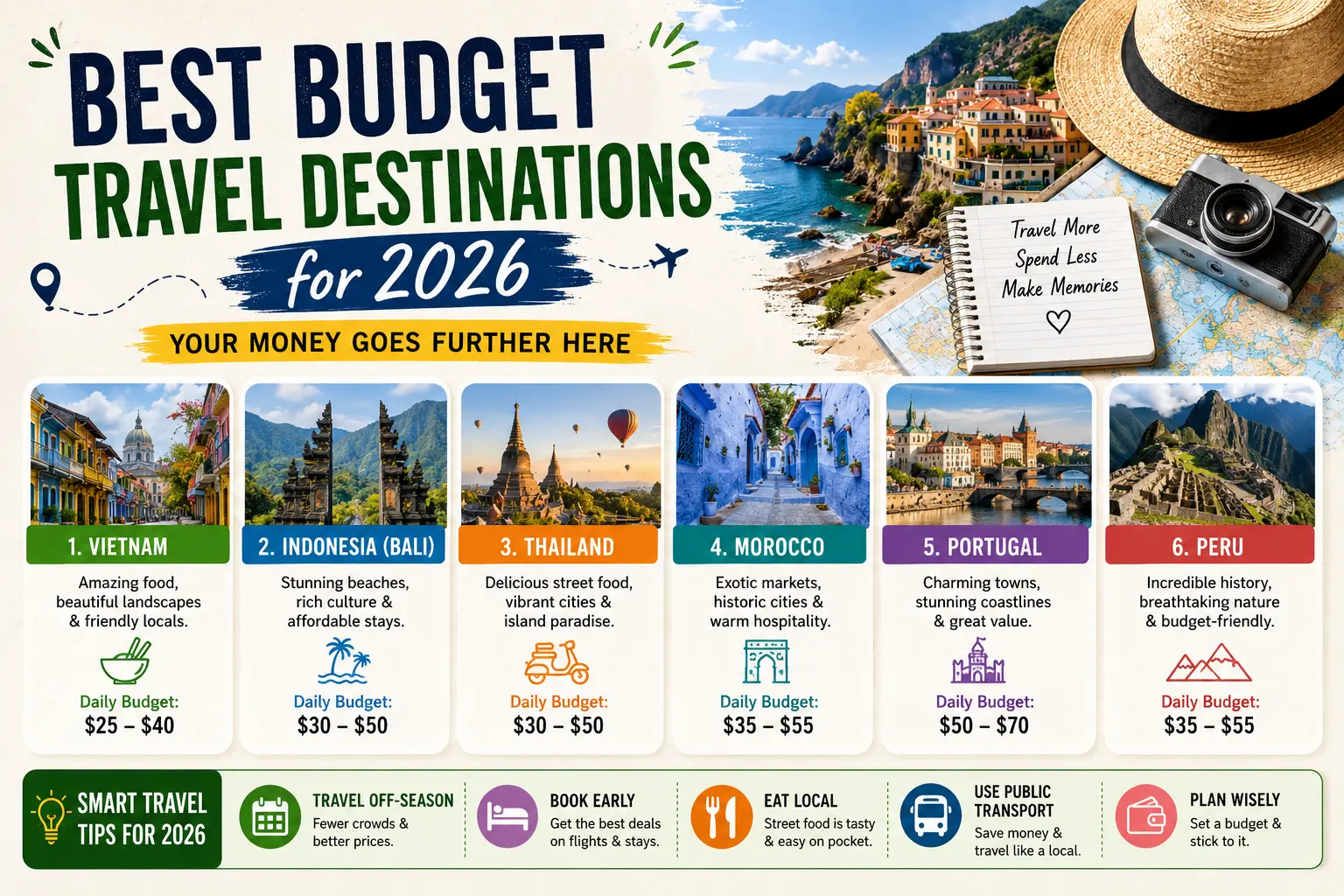
- Vietnam: around $35–$45 per day
- Cambodia: around $30–$40
- Thailand: around $45–$65
- Indonesia: around $40–$60
- Portugal: around $80–$100
These figures should be treated as planning estimates rather than fixed prices. Accommodation choices, activities, transportation, and season can dramatically change your daily spending.
What Is the Cheapest Month to Travel in 2026?
There isn’t one universally cheapest month.
However, January and February, along with certain periods in September through November, can offer lower prices depending on the destination.
Shoulder season is often particularly attractive because you may get better prices without dealing with the weather extremes of low season.
Always check the destination’s specific seasonal patterns before booking.
Can I Travel to Europe on a Budget in 2026?
Absolutely.
You just need to choose destinations carefully.
Portugal, parts of Eastern Europe, and Georgia can offer considerably better value than expensive destinations such as Switzerland, Norway, or Iceland.
You can also save by staying outside the most expensive city centers, using trains and buses, and eating at local restaurants.
Are Southeast Asian Countries Still Cheap in 2026?
Yes, although the region isn’t as inexpensive as it was many years ago.
Vietnam and Cambodia continue to offer particularly strong value.
Thailand and Indonesia can also be affordable, although popular tourist areas such as Bali and certain Thai islands can become significantly more expensive during peak periods.
Is Budget Travel Safe?
Budget travel can absolutely be safe.
Your choice of accommodation, neighborhood, transportation, and activities matters more than simply choosing a low-cost destination.
Research before you arrive, protect your valuables, use reputable transportation, and stay aware of your surroundings.
Don’t assume a country is completely safe or dangerous based solely on its reputation.
How Can I Save Money on Flights in 2026?
Start by being flexible.
Compare several departure dates, check nearby airports, use flight-exploration tools, and consider destinations based on available fares rather than choosing a destination first.
You can also subscribe to reputable flight-deal services to receive alerts about discounts and unusual fares.
The most important thing is to compare the total travel cost, not just the advertised ticket price.
Is Travel Insurance Worth It on a Tight Budget?
For many travelers, yes.
Even a relatively inexpensive trip can become extremely expensive if you face a serious medical emergency, cancellation, or major travel disruption.
Compare policies carefully and make sure the coverage matches your destination, planned activities, and personal circumstances.
Also check whether an existing credit card or other policy already provides some coverage.
Can I Travel on a Budget With a Family?
Absolutely.
Families can save by staying in apartments or vacation rentals with kitchens, choosing free outdoor activities, traveling during less expensive periods, and staying slightly outside the busiest tourist areas.
Planning ahead becomes particularly valuable when you’re booking accommodation for several people.
What’s the Cheapest Way to Stay Connected Abroad?
Depending on your destination and phone compatibility, eSIMs and local SIM cards can both be affordable options.
Providers such as Airalo, Holafly, and Ubigi offer international data plans, while local SIM cards can sometimes provide better value for longer stays.
Before traveling, download offline maps and translation packs so you aren’t completely dependent on mobile data.
Your Budget Trip Starts With One Decision
Here’s the biggest takeaway from everything we’ve covered:
Budget travel isn’t about making your trip miserable.
It’s about making your money work harder.
You don’t have to spend every night in a dorm, eat instant noodles, or avoid every paid experience. You simply need to make deliberate choices about where your money goes.
Choose a destination where your currency has reasonable purchasing power.
Compare flight dates.
Look beyond the obvious tourist areas.
Eat local food.
Use public transportation.
Pack light.
Check the full cost before booking.
And most importantly, leave some room in your budget for the unexpected.
Because some of the best travel experiences aren’t the ones you carefully schedule six months in advance. They’re the little discoveries that happen when you have enough flexibility to say, “Why not?”
So open your flight search.
Try the “Everywhere” option.
Compare a few destinations you hadn’t considered before.
You might discover that your dream trip is much more affordable than you thought.
Your next adventure doesn’t necessarily require a bigger budget. It may simply require a smarter destination.