Have you ever felt like your brain has too many tabs open, and the fan is running at full speed? We all hit that wall where exhaustion meets a racing mind, leaving us tossing and turning at 2 AM or snapping at loved ones over minor inconveniences. When that heavy, tight feeling in your chest becomes a daily visitor, finding a way to decompress isn’t just a luxury—it is necessary for your sanity.
Many people reach for a glass of wine or zone out in front of the TV to cope, but leaning on natural remedies for stress relief offers a gentler, much more sustainable way to bring your nervous system back to baseline. You do not need to overhaul your entire life or spend hours meditating on a mountain to start feeling better. Often, the most effective tools are already in your kitchen pantry or built right into your own biology. Let’s look at exactly what these remedies look like, how they affect your body, and how you can actually fit them into your busy, messy schedule without adding more stress to your plate.
What Are Natural Remedies for Stress Relief?
At its core, a natural stress remedy is any non-pharmaceutical practice, herb, or lifestyle adjustment used to quiet your nervous system and shift your body out of “fight-or-flight” mode. When you are stressed, your body pumps out cortisol and adrenaline, preparing you to outrun a bear—even if the “bear” is just a strongly worded email from your boss. Natural remedies work by sending physical and chemical signals of safety back to your brain, telling it to stand down.
Think of it like this: instead of chugging a third cup of coffee to power through brain fog (which only revs up your anxiety), you might step outside for five minutes of sunlight, practice a specific breathing pattern, or brew a cup of lemon balm tea.
These remedies are about working with your body rather than against it. They rely on simple biology, botanical properties, and mindfulness rather than synthetic chemicals. While they aren’t a replacement for professional medical treatment if you have a clinical anxiety disorder, they are highly effective, beginner-friendly tools for managing the daily overwhelm we all face.
Causes of Everyday Stress
To effectively use natural remedies, it helps to understand what is triggering your stress in the first place. You can’t put out a fire if you don’t know where the matches are.
The Always-On Digital Culture
We were not biologically designed to process the amount of information we see on a smartphone in a single day. Constantly checking work emails at 9 PM, scrolling through negative news, and comparing your life to highlight reels on social media keeps your brain on high alert. This matters because your mind never gets the complete silence it requires to process the day, leading to chronic, low-grade tension that exhausts you before you even wake up.
Blurred Work-Life Boundaries
Since remote and hybrid work became the norm, the physical boundary between “work time” and “rest time” has vanished for many people. If you work from your kitchen table or answer client texts from your couch, your brain stops associating your home with relaxation. This lack of separation means your nervous system stays partially activated all evening. Without a clear transition away from your responsibilities, true rest becomes nearly impossible.
Biological Neglect
Stress isn’t just mental; it is highly physical. Running on four hours of sleep, skipping breakfast, living off caffeine, and staying indoors all day puts your body into survival mode. When your blood sugar crashes or your circadian rhythm is disrupted from a lack of morning sunlight, your body interprets this physical deficit as a threat. It releases stress hormones to keep you functioning, making you feel anxious and on edge even if nothing technically “stressful” happened that day.
Best Ways to Relieve Stress Naturally
When you are feeling overwhelmed, complicated routines are the last thing you want. Here are actionable, realistic ways to naturally lower your stress levels.
1. The 4-7-8 Breathing Technique
Why it works: Your breath is the remote control to your nervous system. By making your exhales longer than your inhales, you stimulate the vagus nerve, which acts as the brake pedal for your heart rate and anxiety.
Practical example: Inhale quietly through your nose for 4 seconds, hold your breath for 7 seconds, and exhale completely through your mouth making a “whoosh” sound for 8 seconds. Do this four times in a row before a stressful meeting.
Mistake to avoid: Don’t force the breath to the point where you feel dizzy. If 4-7-8 is too long, modify it to 3-4-5. The ratio (longer exhale) is what matters, not the exact seconds.
2. Harnessing the Power of Adaptogens
Why it works: Adaptogens are a class of herbs that help your body resist chemical and physical stressors. Ashwagandha, for example, has been shown to lower cortisol levels and balance the endocrine system.
Practical example: Add a half-teaspoon of Ashwagandha root powder to warm milk (or a dairy-free alternative) with a dash of cinnamon an hour before bed.
Mistake to avoid: Expecting it to work like an aspirin. Adaptogens take days or weeks of consistent use to build up in your system and show real benefits.
3. Strategic Magnesium Intake
Why it works: Stress depletes your body’s magnesium levels rapidly, and low magnesium actually makes you more susceptible to stress—it is a vicious cycle. Magnesium helps regulate neurotransmitters and promotes muscle relaxation.
Practical example: Snack on a handful of pumpkin seeds or almonds during your afternoon slump, or swap your evening shower for a warm bath with Epsom salts (which are rich in magnesium sulfate that absorbs through the skin).
Mistake to avoid: Taking the wrong type of magnesium supplement. Magnesium oxide is poorly absorbed and might just upset your stomach; look for magnesium glycinate for relaxation.
4. Grounding (Earthing)
Why it works: Connecting physically with the earth allows your body to absorb negative electrons, which research suggests can neutralize free radicals and reduce inflammation and stress.
Practical example: Take off your shoes and socks and walk barefoot on natural grass, dirt, or sand for 10 minutes.
Mistake to avoid: Walking on concrete or asphalt. These are not conductive surfaces and will not provide the grounding effect.
5. Intentional Brain Dumping
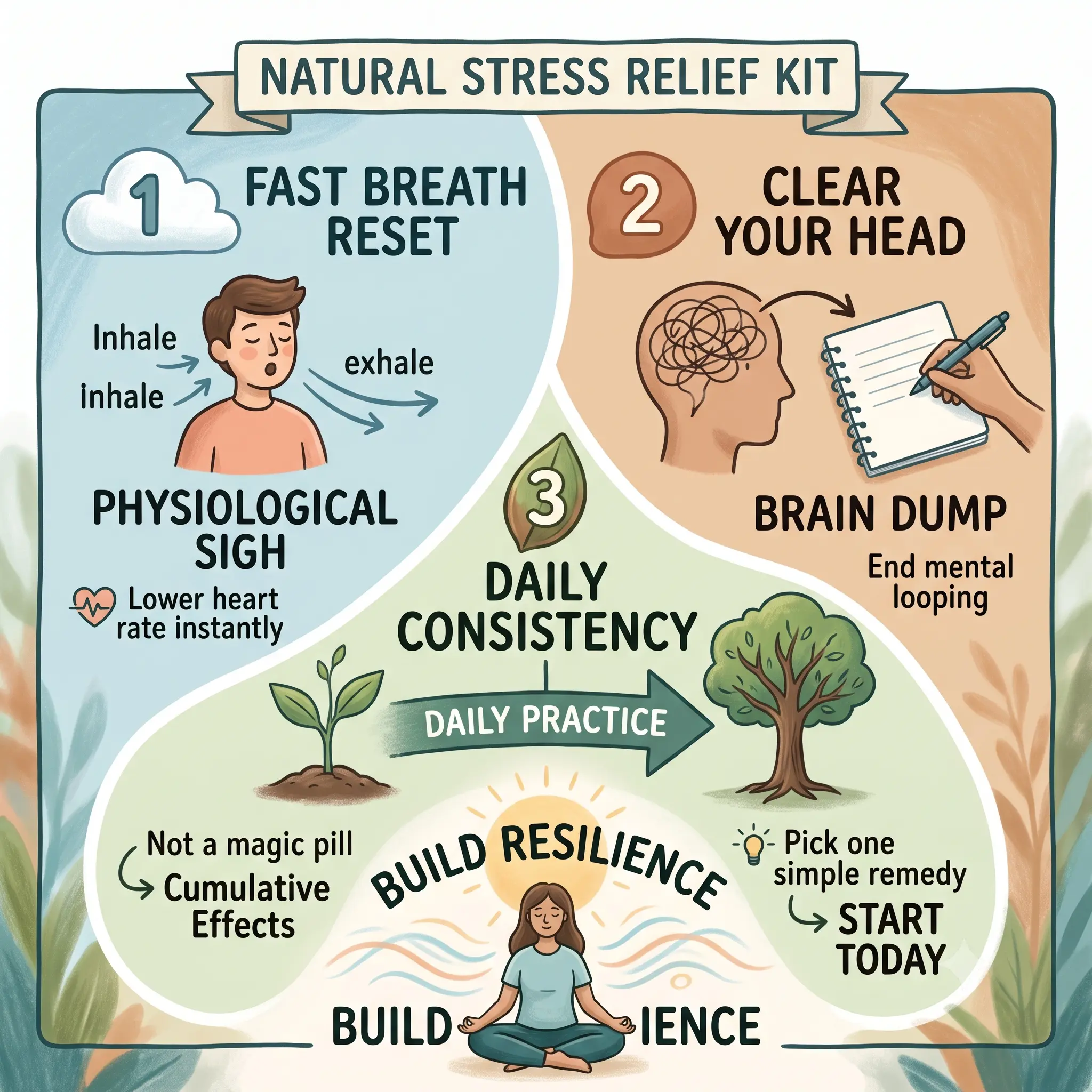
Why it works: Trying to keep track of every task, worry, and conversation in your head requires massive cognitive energy. Writing it down physically removes the burden of memory, telling your brain, “It is safely stored; you can stop looping it.”
Practical example: Keep a basic notebook by your bed. If you can’t sleep, spend three minutes writing down everything on your mind in a messy, bulleted list. Close the book, leaving the worries on the paper.
Mistake to avoid: Worrying about grammar, structure, or making it a “proper” journal entry. Just get the words out quickly.
6. Progressive Muscle Relaxation (PMR)
Why it works: Stress causes you to unknowingly clench your muscles (especially your jaw and shoulders). PMR highlights the contrast between tension and relaxation, forcing the body to physically let go.
Practical example: Lying in bed, tense the muscles in your toes as hard as you can for 5 seconds, then suddenly release. Move up to your calves, then thighs, all the way up to your face, tensing and releasing each muscle group.
Mistake to avoid: Tensing an area so hard that it cramps or causes pain. It should be a firm squeeze, not a painful one.
7. Swapping Coffee for L-Theanine Sources
Why it works: L-theanine is an amino acid that promotes relaxation without drowsiness. It pairs beautifully with caffeine to give you focus without the jittery, anxious crash.
Practical example: If your morning coffee makes your heart race, swap your second cup for Matcha or high-quality green tea. You will still get a gentle energy lift, but the high L-theanine content will keep you calm.
Mistake to avoid: Adding loads of refined sugar to your green tea, which will spike your blood sugar and trigger an entirely different kind of physical stress.
Expert Tips
If you want to take your stress management a step further, here is how the pros approach nervous system regulation:
- The Physiological Sigh: When people fail to calm down during a panic moment, it is often because they take deep, gulping breaths. Instead, try a physiological sigh: take two quick inhales through the nose (one deep, one short to top it off), followed by one long, slow exhale through the mouth. This immediately pops open collapsed air sacs in the lungs and rapidly lowers your heart rate.
- Habit Stack Your Relaxation: People often fail to use natural remedies because they simply forget. Tie your stress relief to an existing habit. For example, practice deep breathing only while your morning coffee is brewing, or do your brain dump while brushing your teeth.
- Morning Sunlight Trumps Evening Melatonin: If your stress is causing sleep issues, don’t just reach for sleep aids. Get outside within 30 minutes of waking up and look toward the sun (not directly at it) for 10 minutes. This anchors your circadian clock, naturally dropping your cortisol levels 12 hours later when you need to sleep.
- Stimulate the Vagus Nerve with Cold: Splashing freezing cold water on your face—specifically targeting the area below your eyes and above your upper lip—triggers the “mammalian dive reflex.” This instantly forces your heart rate to slow down and breaks the loop of a panic attack.
- Use Sour Candy as a Sensory Reset: If you are caught in an intense spiral of anxious thoughts, pop a highly sour piece of candy into your mouth. The intense, unexpected physical sensation shocks your brain into the present moment, breaking the cycle of rumination.
Common Mistakes to Avoid
Even with the best intentions, it is easy to approach natural remedies the wrong way. Keep an eye out for these pitfalls:
- Treating them as one-time magic pills:
- Why it’s harmful: You will assume they don’t work and quit.
- The correct approach: Understand that natural remedies are cumulative. They require consistency to train your nervous system over time.
- Trying to do everything at once:
- Why it’s harmful: Adding a 10-step relaxation routine to an already stressful day just creates more performance anxiety.
- The correct approach: Pick exactly one simple remedy to try for a week.
- Ignoring the root cause of the stress:
- Why it’s harmful: No amount of chamomile tea will fix a toxic workplace or a severe lack of boundaries.
- The correct approach: Use natural remedies to manage your symptoms so you have the clarity to address the actual problem in your life.
- Assuming “natural” means “universally safe”:
- Why it’s harmful: Certain herbs (like St. John’s Wort or Ashwagandha) can interact dangerously with prescription medications.
- The correct approach: Always run a quick search or ask your pharmacist about interactions if you are on daily medication.
- Waiting until you are entirely burnt out to start:
- Why it’s harmful: Trying to learn a breathing technique while in the middle of a breakdown is like trying to learn to swim while drowning.
- The correct approach: Practice your stress relief habits when you are relatively calm, so the neural pathways are strong when you actually need them.
Pros and Cons of Natural Remedies for Stress Relief
Pros:
- Highly accessible: Many remedies, like breathing or sunlight, are completely free.
- Fewer side effects: Generally, herbs and lifestyle tweaks carry a much lower risk of dependency or severe side effects compared to pharmaceuticals.
- Empowering: They teach you how to manage your own physiological responses, building resilience.
- Holistic benefits: Things like improving sleep or eating magnesium-rich foods improve your overall physical health, not just your stress levels.
Cons:
- Requires consistency: They do not offer the instant “off switch” that some medical interventions do.
- Trial and error: What works perfectly for one person (like meditation) might make another person feel more anxious.
- Not a cure for clinical disorders: Natural remedies are for everyday stress and mild anxiety; they cannot replace therapy or medication for severe mental health conditions.
Frequently Asked Questions
How fast do natural stress remedies work?
It depends on the remedy. Breathing techniques, grounding, or a cold water splash can lower your heart rate in less than 60 seconds. However, herbal remedies like adaptogens or lifestyle changes like magnesium supplementation may take one to three weeks of consistent daily use for you to notice a significant shift in your baseline stress.
Can I drink chamomile tea every day?
Yes, for the vast majority of people, drinking chamomile tea daily is entirely safe and highly beneficial. It contains apigenin, an antioxidant that binds to receptors in your brain to promote sleepiness and reduce insomnia. Just avoid it if you have severe allergies to plants in the daisy family.
Do I need to buy expensive supplements?
Absolutely not. The foundation of natural stress relief relies on free tools: your breath, movement, sunlight, and sleep hygiene. Supplements can be a helpful boost, but you can also get necessary nutrients like L-theanine from affordable green tea, and magnesium from beans and leafy greens.
What is the best natural remedy for instant relief?
The physiological sigh is the fastest way to achieve instant relief. Take two quick inhales through your nose to fully expand your lungs, followed by one long, slow exhale through your mouth. Doing this just three times physically forces your heart rate to drop and signals safety to your brain.
Can stress cause physical pain?
Yes. Chronic stress keeps your muscles in a constant state of guarded tension, which frequently leads to tension headaches, jaw pain (from clenching), neck and shoulder stiffness, and even unexplained lower back pain. Releasing mental stress often helps alleviate these physical symptoms.
Are adaptogens safe to take with other medications?
Not always. While natural, adaptogens are potent. For example, Ashwagandha can interact with thyroid medications, blood pressure drugs, and immunosuppressants. You should always consult your doctor or a pharmacist before mixing any herbal supplement with a prescribed medication.
How much time per day do I need to dedicate to stress relief?
You don’t need hours. Just 5 to 10 minutes of intentional practice a day can make a difference. The key is frequency and consistency over duration. Doing a two-minute breathing exercise three times a day is often more effective than a single one-hour meditation session once a week.
Does earthing or grounding actually work?
While it sounds a bit “woo-woo,” a growing body of small-scale scientific studies suggests that direct physical contact with the earth alters our electrical state, helping to reduce inflammation, lower cortisol levels, and improve sleep. At the very least, taking a moment outside away from screens provides undeniable mental clarity.
Is it normal to feel worse when I first try meditating?
Yes, this is incredibly common. When you finally sit in silence, you are no longer distracted, which means all your buried anxious thoughts rush to the surface. If sitting still makes you panic, try “active mindfulness” instead, like walking without headphones or mindfully washing the dishes.
Can certain foods trigger more stress?
Yes. Diets high in refined sugars and ultra-processed foods cause extreme blood sugar spikes and crashes. When your blood sugar crashes, your body releases cortisol to compensate, mimicking the exact physiological feeling of a panic attack. High caffeine intake also heavily contributes to physical stress.
Conclusion
Managing your mental health doesn’t have to mean adding another massive, intimidating project to your to-do list. Natural remedies for stress relief are simply about making small, intentional choices to signal safety to your overwhelmed nervous system. Whether it is stepping outside barefoot for five minutes, swapping your afternoon coffee for a calming tea, or utilizing the 4-7-8 breathing method before opening your email, you have the power to shift how your body feels.
Remember, you cannot pour from an empty cup, and prioritizing your calm is not selfish—it is necessary maintenance. The biggest mistake you can make is trying to implement everything at once. Choose just one remedy from this guide today. Practice it when you are feeling relatively okay, stay consistent with it, and watch how your body rewards you with a steadier, more peaceful mind.