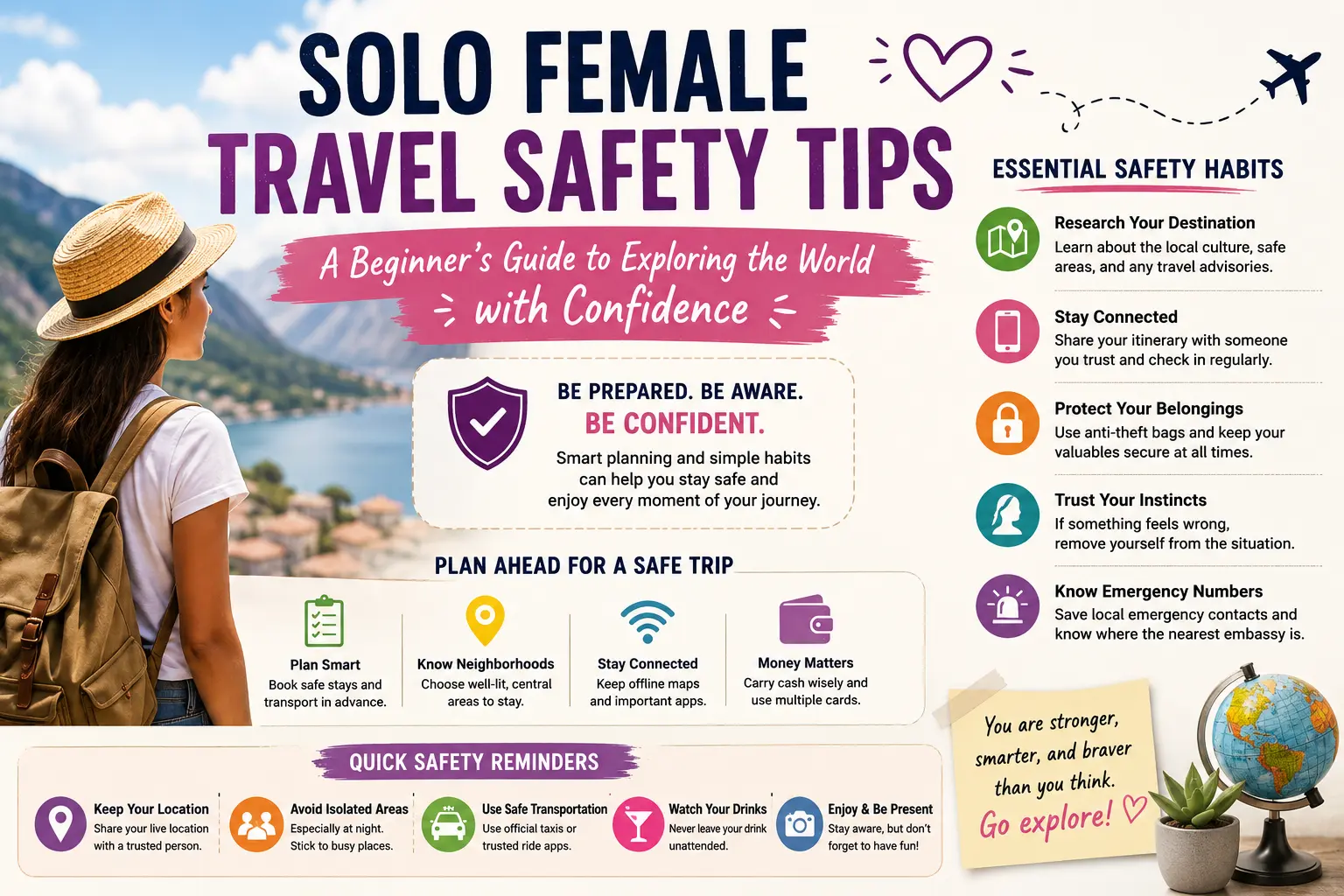
Solo Female Travel Safety Tips: A Beginner’s Guide to Exploring the World with Confidence
You know that little rush of excitement and maybe a touch of anxiety that hits when you finally book a solo trip? It’s exciting to imagine the places you’ll see, the food you’ll try, and the freedom of setting your own schedule. But for many women, there’s another thought sitting in the background: “Am I going to be safe?”
That question is completely understandable.
Traveling alone can expose you to situations you may never encounter at home. Sometimes the risks are obvious. Other times, they’re much more subtle a stranger who won’t take no for an answer, a driver who suddenly changes the route, or someone who seems unusually interested in where you’re staying.
The goal, though, isn’t to spend your entire trip looking over your shoulder.
It’s to develop practical habits that help you recognize uncomfortable situations early, make confident decisions, and enjoy your trip without unnecessary stress.
That’s what good solo female travel safety tips are really about. They aren’t meant to scare you away from traveling. They’re tools that give you more control when you’re somewhere unfamiliar.
So, before you start packing your suitcase or downloading travel apps, let’s build that safety toolkit from the ground up starting with the basics of what travel advice actually means.
What Are Travel Tips, Really?
Travel tips aren’t secret tricks reserved for experienced backpackers. They’re simply lessons people have learned through experience and passed on to other travelers.
Think of them as a collection of “I wish someone had told me this before I left” moments.
Some are simple, such as keeping your passport somewhere secure. Others can make a much bigger difference, like knowing how to get reliable transportation from an airport or recognizing when accommodation doesn’t feel right.
A Simple Example
Imagine arriving in a new city after a long flight. Your phone is nearly dead, you’re exhausted, and all you want to do is reach your hotel.
You find a taxi and climb in. Everything seems fine until you discover later that you paid three times the normal fare.
A simple travel habit could have prevented that:
Ask your accommodation to recommend a reputable taxi service or arrange transportation before you arrive.
That one decision can save you money, frustration, and the uncomfortable feeling of realizing you were taken advantage of.
That’s what practical travel advice does. It helps you make better decisions before a problem becomes a bigger problem.
For solo female travelers, that preparation becomes even more valuable. You’re responsible for making decisions on your own, so having a plan gives you another layer of confidence.
And once you understand the purpose of travel tips, the next question is obvious: Why are they necessary in the first place?
Why Do We Even Need Travel Tips?
Most travel advice exists because travelers repeatedly encounter similar problems.
People make mistakes, share their experiences, and eventually those lessons become recommendations for everyone else.
Here are some of the biggest reasons.
Information Overload
Planning a trip can quickly become overwhelming.
One website tells you to book months ahead. Another recommends waiting. One traveler loves hostels, while another insists that hotels are safer.
With so much conflicting information available, it’s easy to become paralyzed.
Practical example
Suppose you’re choosing accommodation in Rome.
One traveler recommends staying near the main train station because it’s convenient. Another warns against walking there late at night.
Instead of blindly following either opinion, cross-check the neighborhood using several sources and look at recent traveler experiences.
The lesson is simple:
Don’t let one review or one blog determine an important travel decision.
Cultural Differences
Another reason travel advice matters is that cultural expectations vary dramatically between countries.
A gesture that’s perfectly normal at home could be considered disrespectful somewhere else. Clothing expectations, personal space, greetings, and public behavior can all differ.
You can’t know everything before traveling, but learning the basics can prevent awkward situations.
Practical example
In some cultures, certain gestures involving feet, hands, or pointing can be considered disrespectful.
A quick search about local etiquette before visiting a temple, religious site, or traditional neighborhood can help you avoid accidentally offending someone.
Travel tips exist partly because you don’t know what you don’t know.
Unpredictable Human Behavior
Most people you encounter while traveling will probably be perfectly ordinary, helpful people.
But you can’t predict everyone’s intentions.
A friendly stranger might genuinely want to help. Someone offering you a deal might also be trying to take advantage of you.
The important thing is not to assume everyone is dangerous. It’s to maintain reasonable awareness.
Practical example
Someone approaches you in a crowded tourist area and asks for help with a map. While you’re distracted, another person gets close to your belongings.
Rather than automatically assuming the person is innocent or suspicious, create some distance, keep your belongings secure, and move toward a busier location if necessary.
Awareness gives you options.
The “It Won’t Happen to Me” Mindset
Another common problem is assuming that bad experiences only happen to careless travelers.
They don’t.
Even experienced travelers can get distracted, tired, or caught in an unfamiliar situation.
The point of safety advice isn’t to convince you that something bad will happen. It’s to make sure you have a plan if something unexpected does happen.
For example, booking your first night or two of accommodation before arriving can be particularly helpful if your flight lands late.
You don’t want to be searching for a room at midnight while exhausted and unfamiliar with the city.
With that foundation in place, let’s move into the practical strategies that can make solo travel more comfortable and secure.
Best Ways to Stay Safe as a Solo Female Traveler
1. Use the Third-Party Verification Rule
Before booking accommodation, transportation, or an activity, look beyond the seller’s own description.
Check independent reviews, maps, recent traveler experiences, and multiple sources.
Why it helps
A polished listing doesn’t always tell you everything.
Independent information can reveal problems that promotional descriptions don’t mention.
Practical example
You find an attractive apartment online. Before booking, check the address on a map and read recent reviews. If multiple travelers mention poor lighting, difficult access, or uncomfortable interactions with staff, reconsider the booking.
Common mistake
Only reading the five-star reviews.
Instead, check recent lower-rated reviews too. Look for patterns, rather than letting one unusually negative review make the entire decision for you.
2. Consider Carrying a Decoy Wallet
Some travelers choose to carry a separate wallet containing a small amount of cash and an expired or otherwise unusable card.
Your primary cards and important documents remain somewhere more secure.
Why it helps
If you’re ever pressured to hand over a wallet, you may be able to give up the decoy without exposing all your important belongings.
Practical example
Keep a small amount of spending money in an easily accessible wallet while keeping your primary payment cards and emergency funds somewhere separate.
The idea isn’t to provoke or resist a confrontation. Your physical safety comes first.
Common mistake
Putting the decoy wallet inside the same bag as your real valuables.
If someone takes the entire bag, the separation doesn’t help.
3. Establish a Check-In Buddy
Choose someone you trust at home and establish a simple check-in routine.
You might agree to send a message every evening or after reaching a new destination.
For longer trips, you can also agree on what should happen if you miss several check-ins.
Why it helps
Someone knows where you are and can notice when something seems unusual.
Practical example
You might agree to send a short message by 9 p.m. local time after arriving at your accommodation.
You don’t need to create an elaborate system. The important part is consistency.
Common mistake
Setting up a check-in system and then forgetting about it after the first few days.
Make it simple enough that you’ll actually use it.
4. Practice Confident Body Language
You don’t need to act tough or intimidating.
Simply try to look alert and purposeful.
If you’re lost, avoid standing on a street corner staring at your phone. Walk into a café, shop, hotel lobby, or another public place and check your directions there.
Why it helps
Being aware of your surroundings gives you more time to recognize what’s happening around you.
Practical example
You exit a metro station and realize you’re unsure which direction to walk.
Instead of stopping directly outside the station and looking confused, step into a nearby business and check your route privately.
You’re still getting your directions you’ve simply chosen a more comfortable environment to do it.
5. Do a Quick Hotel Room Safety Check
When you arrive at your accommodation, take a couple of minutes to look around.
Check:
- Door locks
- Windows
- Secondary latches
- Peephole
- Fire exits
- Emergency information
- General condition of the room
Know how to reach the nearest exit.
Why it helps
If something goes wrong, you’re less likely to waste valuable time figuring out where to go.
Practical example
You notice that a window doesn’t lock properly.
Instead of ignoring it, report the problem to reception and ask whether it can be fixed or whether another room is available.
Small checks can prevent bigger headaches later.
6. Share Your Location Privately
Location sharing can be useful when you’re traveling alone, particularly while you’re in transit.
Consider sharing your live location with one trusted person when taking a taxi, walking to a destination, or traveling between cities.
Why it helps
Someone you trust can see your general progress and notice if something seems unusual.
Common mistake
Sharing your exact location publicly on social media while you’re still there.
Keep real-time location information private whenever possible.
7. Create a Discreet Safe Word
A simple code word can be useful when you need assistance but don’t want to explain the situation openly.
Choose something ordinary that wouldn’t attract attention.
Practical example
You could agree that mentioning a particular harmless word in a message means:
“Please call me immediately.”
This can be useful if you’re uncomfortable in a taxi, at a social gathering, or in another situation where making an obvious emergency call isn’t practical.
Keep the system simple and make sure your trusted contact understands exactly what the word means.
8. Learn Local Emergency Numbers
Don’t assume your home country’s emergency number will work everywhere.
Emergency systems vary between countries, so research the appropriate number before traveling.
For example, 112 is widely used as an emergency number in Europe, while other destinations may use different numbers.
Save the relevant emergency contacts in your phone before departure.
You should also know how to contact your accommodation, travel provider, and your country’s embassy or consulate if necessary.
Expert Solo Travel Safety Tips
Some of the most useful habits are surprisingly simple.
1. Separate Your Valuables
Don’t keep all your money, cards, and important documents together.
Consider carrying your everyday spending money separately from your backup funds.
Keep copies of important documents in another location as well.
Why it helps
If one bag disappears, you still have access to some of your resources.
This is much better than discovering that your passport, cash, bank cards, and travel documents were all stored together.
2. Don’t Treat the Hotel Safe as Your Only Security
A hotel safe can provide an additional layer of protection, but it shouldn’t automatically be treated as completely secure.
Use sensible judgment about what you leave behind.
Keep essential documents and items with you when appropriate, and avoid leaving unnecessary valuables in your room.
The broader principle is more important than the safe itself:
Don’t rely on a single security measure.
3. Practice Situational Awareness
You don’t need to constantly scan every person around you.
Instead, develop the habit of occasionally looking up and noticing your environment.
When entering a new place, observe:
- Where the exits are
- Who is around
- Whether the area is busy or isolated
- How you’ll leave
- Whether anything feels unusual
This can become second nature surprisingly quickly.
4. Build a Local Contact Network
Before leaving, think about whether you know anyone at or near your destination.
That could be:
- A friend
- Former colleague
- College acquaintance
- Family connection
- Friend of a friend
You don’t need to rely on them throughout the trip.
Simply knowing that someone local exists can provide an additional safety net.
You can also ask locals for practical information such as which neighborhoods are convenient, how transportation works, or what areas are best avoided late at night.
5. Look Beyond Booking-Platform Reviews
Reviews are useful, but don’t stop with the first platform you find.
Look for recent experiences across several independent sources.
Pay attention to repeated complaints rather than isolated comments.
For example, one negative review about a hotel may simply reflect a bad experience. But several recent reviews describing the same security problem deserve much more attention.
Common Mistakes Solo Female Travelers Should Avoid
Even experienced travelers occasionally make poor decisions. The trick is learning from them before they happen to you.
1. Planning Every Minute
A packed itinerary can leave you exhausted.
And when you’re tired, you’re more likely to make careless decisions.
Better approach
Choose your priorities and leave breathing room between activities.
You don’t have to see every attraction in a city to have a great trip.
2. Posting Your Exact Location in Real Time
Posting a beautiful photo isn’t inherently dangerous.
The issue is revealing too much information about where you are right now, especially if you’re traveling alone.
Better approach
Share photos after you’ve left the location and avoid publicly revealing your accommodation details.
3. Ignoring Your Instincts Because You Want to Be Polite
This is an especially important lesson for solo travelers.
You don’t owe anyone continued conversation simply because they approached you politely.
If a person or situation makes you uncomfortable, you can leave.
Better approach
Move toward a busy public area, enter a shop or hotel, contact someone you trust, or seek assistance when necessary.
You don’t need to justify your decision.
4. Keeping Everything in One Place
If your only card, cash, and important documents are in one purse, losing that purse becomes a major problem.
Better approach
Create separate backups.
For example:
- Everyday spending cash in your day bag
- Backup card somewhere separate
- Emergency cash stored separately
- Document copies in another location
That way, one loss doesn’t become a complete travel disaster.
5. Assuming a “Safe” Country Means Zero Risk
Some destinations have strong reputations for safety.
That doesn’t mean every street, neighborhood, or situation is risk-free.
Even in places considered very safe, basic awareness still matters.
Think about safety at the local level, not just the country level.
6. Relying Entirely on Your Phone
Your phone can be incredibly useful, but it can also fail.
The battery can die. You can lose signal. The device can be stolen.
Better approach
Keep offline copies of essential information, including:
- Passport details
- Accommodation information
- Travel insurance
- Emergency contacts
- Transportation details
A small paper backup can be surprisingly valuable.
7. Drinking More Than You Intended
Alcohol can affect judgment and awareness.
If you’re traveling alone, consider setting a personal limit before going out and sticking to it.
Also keep an eye on your drink and don’t leave it unattended.
If you leave a drink behind, ordering another one is safer than assuming it remains untouched.
8. Not Learning Basic Local Phrases
You don’t need to become fluent in another language before traveling.
Learning a few basic phrases can make everyday situations much easier.
Start with words such as:
- Hello
- Goodbye
- Please
- Thank you
- Yes
- No
- Excuse me
- Help
- How much?
- I don’t understand
Even a small effort can make communication smoother and help you feel more comfortable.
Pros and Cons of Travel Safety Tips
Safety advice can be extremely useful, but there are drawbacks to consider too.
Pros
Greater Confidence
Knowing how to respond to common situations can reduce anxiety and help you feel more prepared.
Time and Money Savings
Learning from other travelers can help you avoid expensive mistakes, unreliable transportation, and poor accommodation choices.
Better Awareness
Good safety advice encourages you to notice potential problems before they become serious.
Cultural Respect
Learning local customs can help you avoid accidental disrespect and create better interactions.
Stronger Problem-Solving Skills
The more travel experience you gain, the better you’ll become at handling unexpected situations calmly.
Cons
Information Overload
There is such a thing as too much advice.
Reading dozens of conflicting travel warnings can make you more anxious instead of more prepared.
False Confidence
Knowing safety tips doesn’t make you immune to problems.
Preparation should support good judgment not replace it.
One-Size-Fits-All Advice
A strategy that works perfectly in one destination may not make sense somewhere else.
Always adapt advice to the specific place you’re visiting.
Fear Amplification
Some travel content focuses heavily on worst-case scenarios.
That can make the world seem much more dangerous than it is and discourage people from traveling altogether.
Overdependence on Technology
Apps and tracking tools are helpful, but you should still be able to navigate basic situations without your phone.
The best preparation combines technology with common sense.
Frequently Asked Questions About Solo Female Travel Safety
Is it safe to travel alone as a woman for the first time?
Yes, many women travel alone successfully every year.
Start with a destination that matches your experience level and comfort zone. Research the area, understand local transportation, choose accommodation carefully, and begin with a shorter trip if you’re nervous.
The goal isn’t to eliminate every possible risk. It’s to become comfortable making independent decisions.
What should I do if I feel unsafe in my accommodation?
Take the feeling seriously.
If there’s a specific problem with the room, contact reception and request a solution or room change.
If you genuinely feel unsafe, leave and find alternative accommodation.
Your comfort and safety are more important than worrying about whether you’re inconveniencing someone.
How can I avoid looking obviously like a tourist?
You don’t have to hide the fact that you’re a visitor.
Instead, try to avoid appearing completely distracted or unfamiliar with your surroundings.
Observe how locals dress, keep your phone away while walking when possible, learn a few local phrases, and move confidently.
Being comfortable and aware matters more than perfectly blending in.
What should I pack specifically for safety?
Consider carrying practical items such as:
- Portable phone charger
- Small personal alarm
- Basic first-aid supplies
- Printed copies of important documents
- Spare payment card
- Small flashlight
- Compact luggage or locker lock
You don’t need to turn your suitcase into an emergency kit.
Choose lightweight items that solve realistic problems.
Can I trust reviews on booking websites?
Reviews are useful, but read them critically.
Pay particular attention to:
- Recent reviews
- Repeated complaints
- Safety-related comments
- Neighborhood concerns
- Reports about staff behavior
- Changes in management
Cross-checking information across multiple platforms can give you a clearer picture.
What’s the best way to handle unwanted attention?
You don’t have to continue a conversation simply because someone approaches you.
A firm “No, thank you” followed by walking away is often enough.
If someone continues bothering you, move into a busy business or public area and ask staff for help.
If the situation escalates, contact local authorities or emergency services.
Should I book tours before leaving or after arriving?
Both approaches can work.
Popular attractions with limited availability are often worth booking ahead.
For flexible activities, waiting until you arrive can give you the opportunity to compare options and get local recommendations.
Your travel style and destination should determine the approach.
Which apps should I download before traveling?
Useful categories include:
- Offline maps
- Translation apps
- Currency converters
- Messaging apps
- Ride-hailing services
- Airline and accommodation apps
- Emergency contact information
Download important maps and language packs before leaving so you aren’t dependent on mobile data.
How can I stay connected without expensive roaming?
Depending on your destination, you may be able to use a local SIM or eSIM.
Before purchasing one, compare coverage, data allowances, activation requirements, and prices.
Whatever option you choose, download essential travel information for offline access too.
What should I do if my passport is stolen?
Report the theft to the local police and obtain documentation of the report.
Then contact your country’s embassy or consulate for guidance on replacement or emergency travel documentation.
Having a photocopy or secure digital copy of your passport details can make the process easier.
Keep your financial institutions informed if cards were stolen as well.
Final Thoughts: Your Journey Starts Now
Solo female travel isn’t about eliminating every risk. That’s impossible.
It’s about becoming prepared enough that unexpected situations don’t automatically turn into disasters.
Choose your destination carefully. Research your accommodation. Keep your valuables separated. Share your plans with someone you trust. Learn basic local information. Pay attention to your surroundings.
And most importantly, learn to trust your own judgment.
Confidence doesn’t mean never feeling nervous. Sometimes your instincts will tell you to slow down, change direction, leave a situation, or ask for help. Listening to that feeling is part of being a confident traveler.
At the same time, don’t let fear become the entire story.
The world is full of fascinating places, generous people, incredible food, beautiful landscapes, and experiences you simply can’t have from home.
Preparation gives you the freedom to enjoy those experiences.
So take a breath. Make your plan. Pack thoughtfully. Keep your important information accessible, and then go explore.
You don’t need to be fearless to travel alone. You just need to be prepared, aware, and willing to trust yourself.
Safe travels and enjoy the adventure.