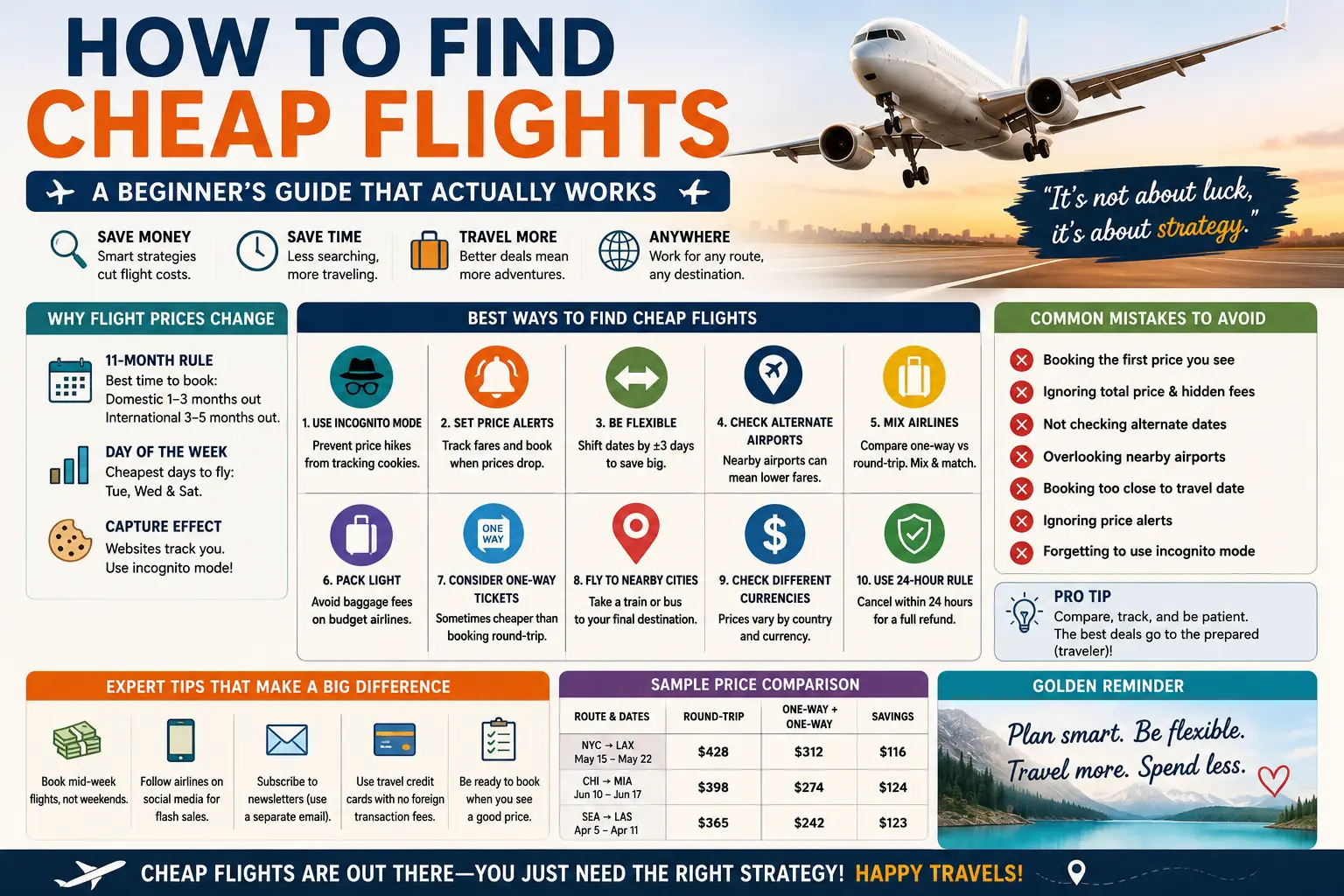
how to find cheap flights
How to Find Cheap Flights: A Beginner’s Guide That Actually Works
Let’s be honest for a moment.
You’ve probably spent hours jumping from one flight-search tab to another, watching prices change while wondering how someone else managed to get the same trip for hundreds of dollars less. You enter your destination, choose your dates, hit search, and suddenly you’re looking at a $1,200 fare for a trip your coworker claims they booked for $400.
Sound familiar?
You’re definitely not the only one.
Finding affordable airfare can feel unnecessarily complicated. There are different fare classes, baggage charges, seat-selection fees, confusing booking rules, and those little messages warning you that only a few seats remain. It can make booking a flight feel more like a strategy game than a simple purchase.
And a lot of the advice online isn’t particularly useful. You’ll often hear things like “just be flexible” or “book on Tuesday,” without anyone explaining what flexibility actually means or which factors genuinely matter.
The good news? Learning how to find cheap flights doesn’t require being a travel expert.
You don’t need airline status, thousands of frequent-flyer miles, or some secret booking website. What you need is a better way to search, compare, and evaluate fares.
Once you understand how airfare works, you’ll be much less likely to panic when you see a high price.
So, let’s start with the basics and break down what finding a cheap flight really means.
What Does “Finding Cheap Flights” Actually Mean?
When people search for how to find cheap flights, they’re usually hoping for one magical trick that instantly reveals the lowest possible fare.
Unfortunately, there isn’t one.
Finding an affordable flight is really about understanding how airline pricing works and knowing which variables you can control.
Airlines don’t sell every seat on an aircraft for the same price. Instead, seats are divided into different fare categories. As availability changes, prices can change too.
Think about a concert.
Imagine there are several seats available for the same event. Some may be sold for $50, others for $80, and premium seats for much more. Once the cheaper seats are gone, the next price level becomes available.
Airline pricing works in a similarly complicated way.
That means two passengers sitting beside each other may have paid completely different prices for their tickets.
So, instead of simply searching once and accepting whatever number appears, smart travelers compare dates, airports, airlines, routes, baggage requirements, and booking options.
You become less of a passive shopper and more of a price detective.
The good news is that you don’t need advanced technical knowledge to do this.
A little flexibility and a systematic search process can make a surprisingly big difference.
Why Flight Prices Change So Often
Before learning how to save money, it helps to understand why airfare changes in the first place.
Many beginners assume flight prices are completely random. They’re not. Airline pricing is influenced by factors such as demand, remaining seat inventory, travel dates, competition, seasonality, and market conditions.
Here are some of the biggest factors to understand.
Booking Too Early or Too Late
One common mistake is assuming that booking as early as possible will always produce the lowest price.
That’s not necessarily true.
Airlines typically publish schedules many months ahead, but the cheapest fare isn’t automatically available the moment a flight is released. At the other extreme, waiting until a few days before departure can also be expensive because fewer seats remain and travelers with fixed schedules may be willing to pay more.
For many domestic trips, travelers often start comparing prices several weeks or months before departure rather than waiting until the final moment. International trips generally deserve even more advance planning.
The important point is not to treat a single booking window as a guaranteed rule.
Instead, start monitoring prices early and look for patterns.
The Day You Fly Can Matter More Than the Day You Book
You’ve probably heard the classic advice about booking flights on Tuesday.
The reality is more complicated.
There isn’t one magical weekday that guarantees the lowest airfare. What often matters more is when you actually travel.
Flights on popular leisure days can be more expensive because demand is higher. If your schedule allows you to move your trip by a day or two, compare several departure and return dates before booking.
For example, a Friday-to-Sunday trip might cost substantially more than a Wednesday-to-Saturday itinerary on the same route.
That’s why flexible-date search tools are so useful.
Instead of asking:
“What’s the cheapest flight on this exact date?”
try asking:
“What’s the cheapest reasonable combination of dates around my trip?”
That small change in approach can reveal options you would otherwise miss.
Do Airlines Raise Prices Because You Keep Searching?
This is one of the most common pieces of flight-booking advice you’ll encounter.
You’ll often hear that airlines track your searches through cookies and deliberately increase prices because you’ve looked at the same route several times.
The reality is more nuanced.
Airfare can change between searches because airlines continuously adjust fares based on demand, availability, competition, and other pricing factors. Seeing a higher price after searching several times doesn’t necessarily mean the airline raised it specifically because of your browsing history.
Using private browsing is still reasonable if you prefer to limit tracking, but don’t rely on incognito mode as a guaranteed cheap-flight hack.
The more useful strategy is to monitor fares, compare options, and understand the normal price range for your route.
Best Ways to Find Cheaper Flights
Now we get to the practical part.
Instead of relying on one supposed “secret,” use several small strategies together. That’s where the biggest advantage comes from.
1. Start With a Flexible, “Use What Works” Mindset
The first step is to stop assuming there’s only one acceptable flight.
If you’re visiting a particular destination, ask yourself:
- Can I leave one day earlier?
- Can I return one day later?
- Is another nearby airport practical?
- Would a nonstop flight actually be worth the extra cost?
- Could I travel at a different time of day?
- Would two one-way tickets work better?
Even small changes can uncover cheaper combinations.
Practical example
Suppose you’re planning a weekend trip.
Your first search shows:
Friday departure + Sunday return = $420
You then check:
Thursday departure + Saturday return = $275
If your schedule allows the change, you’ve saved $145 without using any complicated trick.
Common mistake
Don’t become so focused on finding the absolute lowest number that you ignore convenience.
A $50 cheaper flight isn’t necessarily a bargain if it requires an inconvenient airport, a 12-hour layover, or expensive ground transportation.
2. Set Price Alerts Instead of Constantly Refreshing
One of the easiest ways to monitor airfare is to use price alerts.
Services such as Google Flights, Kayak, and Skyscanner can notify you when prices change for routes you’re watching.
This is much better than repeatedly checking the same search page throughout the day.
Why it helps
Instead of guessing whether today’s fare is good, you can observe how prices move over time.
You may discover that:
- prices are relatively stable,
- prices are gradually increasing,
- prices occasionally fall,
- or the route has unusually high demand.
That information gives you more confidence when it’s time to book.
Common mistake
Don’t assume every alert means “buy immediately.”
An alert simply tells you that something changed. Look at the fare, compare it with alternatives, and decide whether it fits your budget and schedule.
3. Compare One-Way Tickets With Round-Trip Fares
Never assume a round-trip ticket will automatically be cheaper.
Sometimes it is.
Sometimes two separate one-way tickets offer a better deal, particularly when different airlines have competitive fares in each direction.
Example
You might find:
- Airline A outbound: $130
- Airline B return: $115
Total: $245
A round-trip ticket with one airline might cost $320.
In that situation, separate tickets could save $75.
Important caution
Separate tickets aren’t the same as a protected connecting itinerary.
If one flight is delayed and you miss another ticket booked separately, the second airline generally isn’t responsible for the disruption.
For separate bookings, allow plenty of time and understand the risks before committing.
4. Check Nearby Airports
Your closest airport isn’t always your cheapest option.
When searching for flights, check airports within a reasonable distance of both your departure and destination.
For example, a traveler visiting a major city might discover that a nearby secondary airport offers substantially lower fares.
But there’s an important calculation to make.
Don’t compare only:
Airport A flight = $300
versus
Airport B flight = $220
Instead, calculate the complete journey.
If Airport B requires:
- $40 transportation,
- two additional hours,
- and an expensive train or taxi afterward,
the apparent $80 saving might disappear.
Always compare total travel cost and travel time, not just the ticket price.
5. Check Several Departure Dates
Date flexibility is one of the most useful tools for finding better fares.
Instead of searching only one exact date, check a range around your preferred travel period.
Try moving your trip by:
- one day,
- two days,
- or several days if your schedule allows.
Flexible-date calendars make this much easier because you can see multiple prices together.
Example
You might find:
| Travel Dates | Fare |
| Friday–Sunday | $410 |
| Thursday–Sunday | $350 |
| Wednesday–Saturday | $245 |
| Tuesday–Saturday | $225 |
If you have flexibility, that difference can be significant.
Common mistake
Don’t assume your original dates are automatically the best option.
Check first.
6. Don’t Automatically Avoid Budget Airlines
Budget airlines can offer excellent fares, especially for travelers who pack lightly.
The catch is that the advertised fare may cover only the basic transportation.
Additional costs can include:
- carry-on baggage,
- checked luggage,
- seat selection,
- priority boarding,
- food,
- and other optional services.
That’s why you should compare the final price, not the headline fare.
A $70 ticket isn’t actually cheaper than a $130 ticket if the first airline charges another $80 for the things you need.
Practical rule
Before booking a budget airline, calculate:
Base fare + baggage + seat + transportation + other required fees = actual cost
Then compare that number with competing airlines.
7. Understand the 24-Hour Cancellation Rule
For flights covered by U.S. Department of Transportation rules, airlines generally must either allow passengers to cancel within 24 hours for a full refund or provide a 24-hour hold option, provided the ticket was purchased at least seven days before departure.
However, the exact requirement and eligibility can depend on how and where the booking is made, so always check the applicable terms.
The important lesson is that travelers may have a short window in which they can reconsider a booking.
If you use this option, set a reminder.
Don’t assume you’ll remember the deadline automatically.
8. Look at Nearby Destination Cities
Sometimes the cheapest way to reach your destination is to fly somewhere nearby and continue by train, bus, or another form of transportation.
For example, if flights directly into a major city are unusually expensive, check airports in nearby cities.
Then calculate:
Flight + ground transportation + extra travel time
If that total is significantly cheaper, the alternative route may make sense.
Common mistake
Don’t get distracted by an extremely cheap airfare if the rest of the journey costs almost as much.
A $150 flight isn’t a bargain if the additional transportation costs $140.
9. Watch Price Trends Instead of Guessing
Price alerts are useful, but they’re even more helpful when combined with observation.
Suppose you’re monitoring a flight several months before departure.
You might see:
- $920
- $875
- $840
- $790
- $815
- $760
That doesn’t guarantee the price will continue falling.
But tracking the trend helps you understand whether you’re looking at a relatively normal fare or an unusually attractive one.
The goal isn’t to predict the future perfectly.
It’s to make a better-informed decision than simply booking the first price you see.
Expert Tips for Finding Better Airfare
Once you’ve mastered the basics, a few additional strategies can help you make smarter decisions.
Compare the Airline’s Website After Finding a Fare
Flight-search websites are excellent for comparison shopping.
But after finding an attractive fare, check the airline’s own website too.
Sometimes the direct fare is identical. Sometimes it differs.
Booking directly can also make communication easier if your flight is changed or disrupted.
If a third-party site is substantially cheaper, carefully review its cancellation and customer-service policies before booking.
Consider the Real Value of a Nonstop Flight
A nonstop flight isn’t always worth paying a large premium for.
Suppose you have two choices:
Nonstop: $450
One stop: $280
If the connection is reasonable and the schedule works, saving $170 might be worthwhile.
But don’t automatically choose the cheapest itinerary either.
A very long layover, airport change, or tight connection can turn a cheap ticket into a stressful travel day.
Think about the entire journey.
Compare the Total Cost, Not the Headline Fare
This is one of the most important rules in airfare shopping.
The number you see first isn’t always the number you’ll pay.
Consider:
- baggage,
- seat selection,
- airport transportation,
- meals,
- change fees,
- cancellation restrictions,
- and other required costs.
The cheapest flight is the one with the lowest overall cost for your needs, not necessarily the lowest advertised base fare.
Hidden-City Ticketing: Why You Should Be Careful
You may come across a strategy called hidden-city ticketing.
This involves booking a flight where your intended destination is the connection point and then skipping the final segment.
For example, a traveler might find:
City A → City B → City C
for less than:
City A → City B
and decide to leave the airport in City B.
While this strategy has attracted attention online, it comes with significant drawbacks.
You generally can’t check baggage because checked luggage may continue to the ticketed final destination. Skipping a segment can also cause the airline to cancel the remaining itinerary.
Airlines may also prohibit or restrict this practice under their contract of carriage.
For beginners, it’s usually much safer to focus on legitimate methods such as flexible dates, alternate airports, fare alerts, and comparing airlines.
Check Currency Carefully on International Booking Sites
When booking internationally, you may sometimes see prices displayed in different currencies.
It’s worth checking the final cost carefully before choosing a payment currency.
However, don’t assume that switching currencies automatically produces a discount.
Consider:
- the current exchange rate,
- foreign transaction fees,
- the card issuer’s conversion rate,
- and any fees charged by the booking platform.
The displayed local-currency price may look cheaper while actually costing more after conversion.
Always compare the final amount you’ll actually pay.
Common Flight-Booking Mistakes to Avoid
Even a good strategy can fail if you overlook the basics.
Mistake 1: Booking the First Fare You See
The first result isn’t necessarily the best option.
Better approach
Compare several airlines, dates, airports, and booking channels before committing.
Mistake 2: Ignoring the Final Price
A cheap-looking fare can become expensive after baggage and other fees.
Better approach
Always compare the final price for the services you actually need.
Mistake 3: Assuming Round-Trip Is Always Cheapest
It isn’t.
Better approach
Compare the round-trip fare with two separate one-way tickets.
Mistake 4: Refusing to Change Your Travel Dates
Your preferred date may simply be expensive.
Better approach
Check a flexible-date calendar and look at nearby departure and return dates.
Mistake 5: Believing Every Flight-Search Myth
Advice such as “always book Tuesday at 3 AM” or “airlines definitely increase your fare because you searched twice” is often presented far too confidently.
Better approach
Focus on measurable factors such as fare availability, demand, flexibility, and total cost.
Mistake 6: Waiting Until the Last Minute
Last-minute deals do occasionally happen, but they’re unpredictable.
Better approach
Start monitoring prices well ahead of your trip, especially for important or peak-season travel.
Mistake 7: Never Setting a Price Alert
Without tracking prices, it’s difficult to know whether today’s fare is reasonable.
Better approach
Set an alert as soon as you know your approximate destination and travel dates.
Mistake 8: Ignoring Alternate Airports
Your nearest airport isn’t automatically your cheapest option.
Better approach
Check nearby airports and calculate the complete cost of using them.
Pros and Cons of These Cheap-Flight Strategies
No strategy works perfectly for every trip. Here’s the honest trade-off.
The Pros
You Can Save Significant Money
Comparing dates, airports, airlines, and fare types can potentially reduce your travel costs considerably.
Even saving $50 or $100 per ticket becomes meaningful when you’re booking for multiple people.
You Have More Control
Instead of simply accepting the first fare presented to you, you’re making an informed choice.
You can decide which trade-offs are worth making.
You Discover More Options
Flexible searches can reveal routes and combinations you wouldn’t have considered otherwise.
You Don’t Need Elite Status
Most of these strategies don’t require airline status, miles, or premium credit cards.
That makes them accessible to beginners.
The Cons
It Takes More Time
Comparing several options is slower than clicking the first acceptable fare.
You Can Overthink the Decision
Watching prices endlessly can make you hesitate until a good fare disappears.
At some point, you have to decide what price you’re comfortable paying.
Budget Fares Can Have Extra Costs
The cheapest advertised fare may not be the cheapest complete journey.
There Are No Guarantees
Airfare depends on supply, demand, competition, seasonality, and many other factors.
A strategy that works on one route may not work on another.
Some Advanced Tactics Carry Risks
Separate tickets and unconventional booking methods require extra caution.
For beginners, straightforward bookings are usually the safer choice.
Frequently Asked Questions
What is the best day of the week to book a flight?
There isn’t a universally reliable weekday that guarantees the lowest airfare.
Rather than obsessing over the day you book, focus on comparing different travel dates, monitoring prices, and setting fare alerts.
Can incognito mode guarantee cheaper flights?
No.
Private browsing can limit some tracking, but it doesn’t guarantee a lower airfare. Prices can change because of normal airline pricing and availability.
Use it if you prefer, but don’t treat it as a secret discount button.
Is it cheaper to book directly with the airline?
Not always.
Third-party sites can sometimes display competitive prices, while booking directly with the airline may offer advantages when dealing with changes or disruptions.
Compare both before making your decision.
How far ahead should I book an international flight?
There isn’t one perfect number of months that works for every route.
A practical approach is to begin monitoring international flights several months before departure and use price alerts to track changes.
Peak-season travel usually deserves more advance planning than an off-season trip.
Why do flight prices keep changing?
Airlines continuously adjust fares based on factors such as demand, available seats, competition, timing, and market conditions.
That’s why the same flight can have different prices on different days.
Is it cheaper to book two one-way tickets?
Sometimes.
Two one-way fares from different airlines can occasionally beat a round-trip ticket.
Always compare both options before booking.
What hidden fees should I look for?
Pay particular attention to:
- carry-on baggage,
- checked baggage,
- seat selection,
- priority boarding,
- change or cancellation restrictions,
- and booking or service fees.
The important number is the final amount you’ll pay.
Are last-minute flight deals real?
They can happen, but they’re unpredictable.
If your travel dates are flexible, you might occasionally find a late deal. But if you absolutely need to travel on a specific date, waiting until the last minute is risky.
Should I sign up for airline newsletters?
It can be useful if you want to hear about sales and promotions.
If you don’t want your primary inbox filled with travel emails, consider creating a separate email address specifically for travel deals.
Is hidden-city ticketing safe?
It carries risks and may violate an airline’s terms.
Issues can include losing the remaining itinerary, baggage complications, and potential consequences for frequent-flyer accounts.
For most beginners, conventional booking strategies are a better choice.
Final Takeaway: Finding Cheap Flights Is About Searching Smarter
Let’s bring everything together.
Finding a cheap flight isn’t about discovering one secret website or knowing a magical booking time.
It’s about developing better habits.
Compare several travel dates. Check nearby airports. Look at one-way and round-trip options. Set price alerts. Compare the airline’s website with third-party booking platforms. And most importantly, look at the complete cost, not just the attractive number shown at the beginning of the search.
You also don’t need to use every strategy for every trip.
Sometimes the best move is simply shifting your departure by a day.
Other times, an alternative airport can save you a significant amount.
And sometimes the cheapest flight isn’t worth the inconvenience.
The goal isn’t to spend five hours hunting for a ticket that’s $10 cheaper.
It’s to become good enough at comparing airfare that you can recognize a genuinely worthwhile deal when you see one.
So, the next time you’re planning a trip, don’t immediately click the first fare that looks reasonable.
Open your search. Check a few nearby dates. Compare airports. Look at the final price. Set an alert if you’re not ready to book.
Those simple steps can turn flight shopping from a frustrating guessing game into a much more manageable process.
You don’t need to be a travel expert to pay less for airfare. You just need to search with a little more patience and a lot more awareness.
Safe travels and happy saving.